
In a world where content is shifting faster than ever, one thing remains unchanged: South Park will always go there.
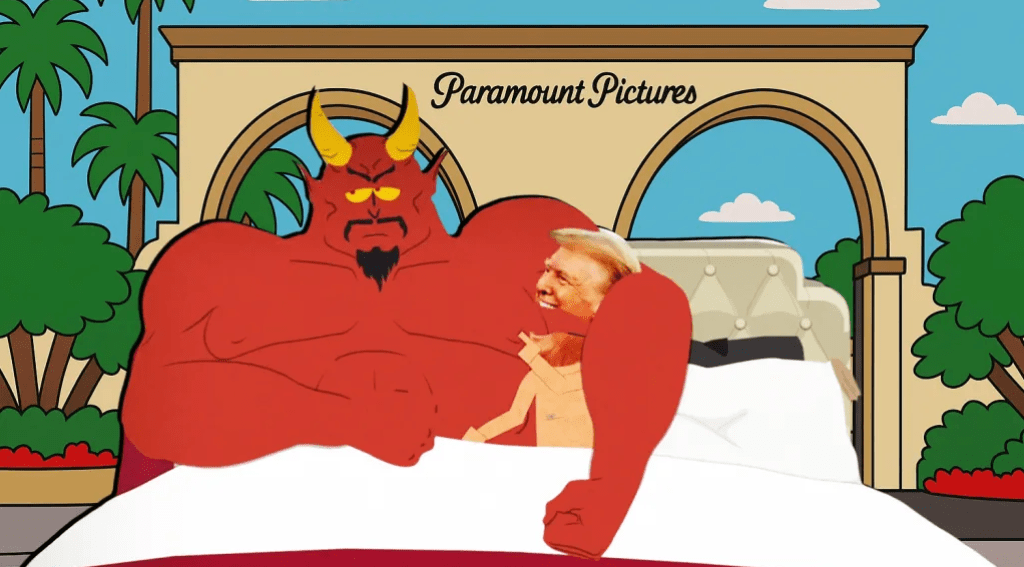
Matt Stone and Trey Parker returned with the Season 27 premiere of South Park, and they did not hold back. The episode, titled “Sermon on the ’Mount,” is an all-out blitz on modern politics, AI, censorship, and President Donald Trump himself—whose appearance in the episode includes, yes, a disturbingly memorable visual joke involving a fully rendered micropenis. It’s crude. It’s chaotic. And it’s very much South Park.
But here’s the truth: comedy has never been one-size-fits-all. In today’s world—where social media, streaming, and AI content are reshaping how we consume and define humor—there’s room for all kinds of funny. Some shows embrace sarcasm and subtlety (The Office, The Good Place, Fresh Off The Boat), while others lean into layered commentary with a wink (Curb Your Enthusiasm, Seinfeld, Atlanta, Arrested Development). But South Park? It strips away the filter and dares to laugh at the absurdity of everything—especially the things we’re told not to laugh at.
The Evolution of Humor in a Post-Satire Era
With the rise of AI, YouTube algorithms, and a social climate that shifts by the day, the definition of what’s “funny” is more personal and polarized than ever. Where some audiences seek comfort comedy or character-driven wit, others want bold satire that kicks the fourth wall down.
South Park thrives on this friction. Whether lampooning Hells Angels, political figures, or the entire entertainment industry, Parker and Stone are masters of poking fun at how seriously we take ourselves. Their commentary doesn’t just aim at the obvious—it’s a reflection of how media, politics, and culture intersect in ridiculous, sometimes dangerous ways.
In “Sermon on the ’Mount,” Trump isn’t hidden behind the Mr. Garrison mask anymore. He’s here, full frontal (literally), as a symbol of how far reality itself has bent toward parody. The episode takes jabs not just at politics, but at Paramount, CBS, AI regulations, and the fragility of free speech in a corporate-run media landscape. It’s no longer satire. It’s performance commentary with an AI twist.
South Park and the Rise of AI-Satire
The most jaw-dropping moment of the episode? A live-action-style pro-Trump propaganda ad, generated using transparent AI tools, where Trump is shown marching, stripping down, and declaring support for the show’s fictional settlement. The creators even made a real site—HeTrumpedUs.com—blurring the lines between the show and reality, fiction and digital fabrication.
As AI continues to change how content is made, South Park has jumped into the conversation, not to warn—but to mock it, merge with it, and maybe even master it.
Why It Matters: Comedy’s Job Isn’t to Be Comfortable
Not every show will (or should) go as far as South Park, but in a digital age ruled by platforms, algorithms, and AI curation, we need content that pushes boundaries. Satire helps us make sense of chaos. Crude or clever, uncomfortable or hilarious, comedy has always helped us see ourselves more clearly.
As platforms evolve and creators adapt, South Park reminds us that laughter—whether through a micropenis joke or a school named after Jesus—is still one of the sharpest tools we have to cut through the noise.




Leave a comment